
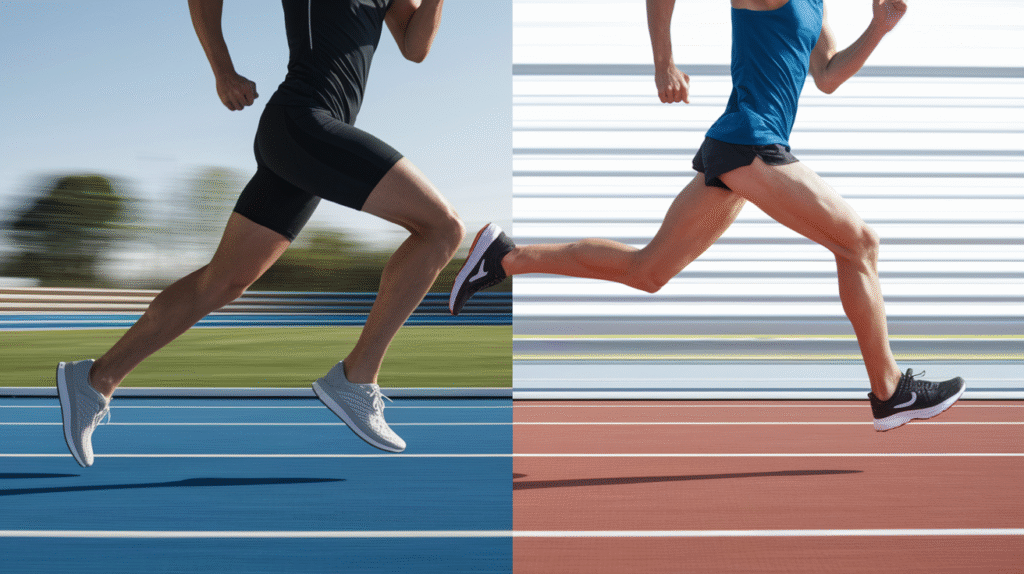
If you are choosing between barefoot shoes and cushioned running shoes, the real question is not which style looks more advanced—it is which one helps you run efficiently, comfortably, and consistently. For most runners, the better option depends on your current stride, training background, and how much adaptation you are willing to make.
If you want the broader minimalist-footwear context as you read, the barefoot running shoes guide is a useful companion page, but this article stays tightly focused on running economy and the tradeoffs that matter at decision time.
Quick Verdict
Barefoot shoes can support a more economical stride for some runners, especially those who already land lightly on the forefoot or midfoot. Cushioned shoes usually make the transition easier, reduce lower-leg load for many runners, and are often the safer choice if you are new to minimal footwear or running longer distances on hard surfaces.
| Decision factor | Barefoot shoes | Cushioned shoes |
|---|---|---|
| Running Economy | Can improve efficiency when form adapts well and shoe mass is low | Often efficient in practice because it is easier to keep a stable, repeatable stride |
| Biomechanics | Encourages more foot feedback, shorter contact, and lighter loading | Adds protection and can smooth impact variability |
| Transition Cost | Higher; calves, feet, and Achilles usually need time to adapt | Lower; usually easier for immediate daily training |
| Injury Risk Profile | May reduce some loads but can raise stress if you change too fast | Often better tolerated at first; less abrupt change for the lower leg |
| Best Fit | Experienced runners seeking more ground feel and a minimalist setup | Most runners prioritizing comfort, protection, and easy mileage |
What Running Economy Actually Means
Running economy is the amount of oxygen and energy you need to hold a given pace. A runner with better economy can usually run the same pace with less effort, or run faster before fatigue builds. That is why shoe choice matters: even small changes in mass, stiffness, cushioning, and footstrike pattern can shift how your body spends energy stride by stride.
The original research behind this topic points in two directions at once. On one hand, minimalist and barefoot-style shoes can encourage a shorter ground contact time and a lighter, more reactive stride. On the other hand, cushioned shoes may let many runners maintain a steady gait with less muscular strain, especially when mileage, pace changes, or surface conditions make form less consistent. That is why the most honest answer is not universal—it is runner-specific.
For readers who want to compare the broader barefoot-shoe category with other use cases, the running in Xero Shoes guide adds practical context, while this page stays centered on the efficiency question.
What The Evidence Suggests About Barefoot Shoes Vs Cushioned Shoes
The strongest pattern in the material you are comparing is not that one shoe type always wins, but that each changes the mechanics of running in a different way. Barefoot shoes reduce the amount of material between the foot and the ground, which can improve sensory feedback and often nudges runners toward a forefoot or midfoot strike. That shift may lower certain braking and loading patterns and can be associated with shorter ground contact times.
The article’s original oxygen-consumption discussion fits here: runners in minimalist footwear can show lower oxygen use in some studies, especially when they are already adapted to the style. That said, lower shoe mass and greater proprioception do not automatically make every runner more economical. If the change causes extra calf work, tension in the Achilles, or a stride that feels forced, any theoretical gain can disappear quickly.
Cushioned shoes, meanwhile, often look less dramatic biomechanically, but that can be a feature rather than a flaw. When a shoe buffers impact and feels stable, runners may preserve form deeper into a session and keep pace more consistently. In practical terms, that can translate to better real-world economy for some athletes, particularly on easy runs, longer road sessions, or during periods when they are training hard and want fewer lower-leg demands.
Ground Contact Time Is Part Of The Story, Not The Whole Story
Ground contact time matters because it reflects how long your foot stays on the ground before the next stride. In the original draft, the elite-runner range of roughly 185-220 milliseconds was used to illustrate how quicker transitions can support a more efficient rhythm. That remains a useful benchmark, but it should be read carefully: a shorter contact time is not automatically better if it comes from overstriding, tension, or poor load tolerance.
A better way to interpret the evidence is this: barefoot shoes may help some runners find a quicker, lighter contact pattern, while cushioned shoes can help others preserve a smooth rhythm without needing to consciously alter technique. If your current form already looks economical, the best shoe may be the one that supports it most consistently rather than the one that imposes the biggest change.
Injury Risk, Adaptation, And When Cushioning Still Makes Sense
The original article cited longitudinal injury findings, including a 2-year follow-up that reported lower tibial stress fracture rates in a barefoot-shoe group. That kind of result is worth noting, but it should not be treated as a blanket endorsement. Lower incidence in one study can reflect many factors: the runners selected, how they transitioned, their training volume, and whether they were already stronger or more adapted to minimalist movement.
What matters for most runners is adaptation speed. Barefoot shoes place more demand on the foot, calf, and Achilles complex. If you change too fast, stress can move from the shoe to your tissues before they are ready. Cushioned shoes reduce that abruptness, which is why they often remain the safer choice for beginners, higher-mileage runners, or anyone returning from a lower-leg issue.
That is also why this page does not frame minimalist footwear as an automatic upgrade. The more useful conclusion is that barefoot shoes can be a performance tool when the runner is ready for them, while cushioned shoes are a more forgiving platform for most daily training. If you are actively considering a switch, the transition guide for barefoot shoes is the right next stop before you make the move.
When To Choose Each Type
For runners who are already leaning minimalist and want model-level context, the transition guide and the running-in-Xero article work well together: one helps you adapt, the other helps you understand what minimalist running feels like in practice.
Timing Matters: When To Switch, When To Wait
The best time to experiment with barefoot shoes is usually when your training load is stable, not when you are building toward a race or adding mileage. The body adapts better when the change is small, predictable, and easy to monitor.
Choosing The Right Next Step
If you want the performance upside of barefoot shoes, treat them as an adaptation project, not a same-day replacement. If you want the least risky route to consistent mileage, cushioned shoes still make excellent sense. The right choice is the one that matches your form, your training phase, and your tolerance for change.
For readers building a broader minimalist-shoe shortlist, the most useful path is to compare the running benefits first, then move into fit and transition guidance before buying.
Frequently Asked Questions
Are Barefoot Shoes Better Than Cushioned Shoes?
Not for everyone. Barefoot shoes can improve ground feel and help some runners become more economical, but cushioned shoes are often easier to tolerate and may be the better daily-training choice for many people.
What Are The Drawbacks Of Barefoot Shoes?
The main drawbacks are adaptation demands, extra load on the calves and Achilles, and a higher chance of overuse problems if you switch too quickly or use them for too much mileage too soon.
What Do Podiatrists Say About Going Barefoot?
The usual advice is cautious rather than absolute: some barefoot-style work may help foot strength and movement awareness, but rapid transitions can also trigger pain if your feet and lower legs are not prepared.
Why Do People Quit Wearing Barefoot Shoes?
Common reasons include calf soreness, foot fatigue, discomfort on longer runs, and realizing they prefer the easier feel of cushioning for everyday training.
What Is The Healthiest Shoe For Your Foot?
The healthiest shoe is the one that matches your current mechanics, training volume, and tissue tolerance. For some runners that means minimalist footwear; for many others it means a cushioned shoe that supports steady, pain-free mileage.

Jessica Linford is an insightful author for My Shoes Finder, where she explores a wide array of general topics that resonate with everyday readers. With a passion for storytelling and a keen eye for detail, she brings a unique perspective to her writing, aiming to inform and inspire through her engaging content. Jessica’s diverse interests drive her curiosity, allowing her to connect with audiences on various subjects while sharing practical tips and relatable anecdotes.
See also:
 Carbon Plate Running Shoes And Running Economy: What They Actually Improve
 Barefoot Shoes And Knee Pain Prevention: What The Science Suggests In 2025
 Barefoot Running Benefits: What It Can Improve, What To Watch For, And Whether It’s Worth Trying
 Running In Xero Shoes: Who They Suit And How To Transition Safely
 How To Improve Your Running Stride And Footwork
 Are Barefoot Shoes Good For Yoga And Meditation? A Practical Guide
This topic is so relevant for anyone who runs regularly! I’ve been experimenting with both barefoot shoes and cushioned ones, and it’s interesting to see how each impacts my technique and comfort. I’ve noticed that barefoot shoes demand more attention to form, which has improved my awareness of my footstrike and overall biomechanics. However, I’ve also found that cushioned shoes give me a little extra protection during longer runs, especially on harder surfaces.
This is a fascinating deep dive into the nuances of footwear, and I can’t help but chuckle at my own running mishaps! I once thought I could channel my inner gazelle in a pair of minimalist shoes, only to discover that I instead resembled a very confused flamingo. Turns out, the right shoe can mean the difference between gracefully bounding down the trail and twisting an ankle on a coffee run.
It’s fascinating to consider how footwear choices can shape our running journeys! I’ve personally experienced a notable difference in my own running economy after switching to barefoot shoes. Initially, I was skeptical about the lack of cushioning, but I found that it encouraged me to pay more attention to my form and footstrike. It helped enhance my proprioception, making each run feel more connected to the ground.
It’s really interesting to hear about your experience with barefoot shoes and how it’s reshaped your running journey. Many people find that making the switch can feel like stepping into a whole new world of running. You mentioned the initial skepticism about the lack of cushioning, which is totally understandable. In a way, it’s like stepping away from the comfort zone we’ve grown accustomed to and trying something that feels more raw and, well, authentic.
You capture the essence of the transition to barefoot shoes so well. It really does feel like stepping into a whole new world of running, doesn’t it? For me, that initial skepticism was definitely a hurdle. The idea of trading in my cushioning for a more ‘raw’ experience was daunting at first, but I found that it pushed my boundaries in a really interesting way.
I’m really intrigued by the impact of footwear on running economy! I’ve experimented with both barefoot shoes and traditional cushioned runners in my training, and I’ve found that barefoot options seem to encourage a more natural stride, which definitely makes me feel more connected to the ground. It’s fascinating to see how this choice can influence biomechanics and potentially reduce injury risk.
It’s really interesting to hear about your experience with barefoot shoes. That connection to the ground can make a big difference in how we feel during a run. There’s something about that minimalist approach that seems to prompt better form for a lot of runners.
It’s interesting how that connection to the ground really transforms the experience of running. When I first transitioned to barefoot shoes, I noticed a significant shift in my form. It made me more conscious of my footstrike and posture. I think there’s something intuitive about running with less cushioning that encourages a more natural stride.
It’s great to hear about your experience with both barefoot shoes and traditional cushioned runners. The connection you feel with the ground while using barefoot options really highlights an aspect of running that many people overlook—how footwear can influence not just performance but our overall running experience. There’s something undeniably profound about the sensation of your feet interacting directly with the surface, embracing the feedback it gives you.
I really appreciate this discussion about the impact of footwear on running economy. It’s such an important topic for anyone who laces up their shoes and hits the pavement—whether you’re speeding along a marathon course or just jogging around the neighborhood. I’ve personally found that my relationship with shoes has evolved quite a bit over the years.
This is such a fascinating topic! I’ve been experimenting with different types of footwear in my own running routine, and I’ve definitely noticed some differences in my performance. Going from cushioned shoes to more minimalist options was a big shift for me, both physically and mentally. At first, I felt more connected to the ground, which made me more aware of my stride, but it also challenged my calf muscles in a way I wasn’t used to.
This analysis of footwear’s impact on running economy resonates with me as I’ve experienced the significant differences between barefoot and cushioned shoes firsthand. Transitioning to a minimalist shoe has not only improved my form but has also compelled me to pay closer attention to my biomechanics, especially my footstrike and overall posture. I’ve found that making this switch has improved my efficiency, but it required a period of adaptation to avoid injuries.
It’s interesting to hear how your transition to minimalist shoes has influenced your running. I think a lot of runners underestimate the importance of footstrike and overall biomechanics until they make a change like that. It’s almost like you have to re-learn how to run when you shift to a different style of footwear, isn’t it?
I recently came across an article that dives into the unique benefits of barefoot shoes for walking, and it echoes my own journey with minimalist footwear—definitely worth checking out if you’re curious about the fit and advantages they offer.
‘Barefoot Shoes For Walking: Benefits, Fit, And Who They Suit Best’
https://myshoesfinder.com/barefoot-shoes-for-walking-explore-their-unique-benefits/.
Your exploration of footwear’s impact on running economy presents a fascinating intersection of biomechanics and personal performance. I’ve found that the choice between barefoot shoes and cushioned options can dramatically influence not just efficiency, but also the overall running experience. For example, when I transitioned to minimalist shoes last year, I noticed a significant change in my footstrike pattern; I became more mindful of my form and developed a more efficient stride, which I didn’t expect from just altering my footwear.
This analysis on footwear and running economy resonates deeply with my own experiences as a distance runner. Transitioning to barefoot shoes helped me not only improve my biomechanics but also foster a greater connection with the ground, enhancing my awareness of form and footstrike. However, I often wonder how individual anatomy plays a role in this debate. For instance, runners with flat feet or specific injuries might have very different outcomes compared to those who naturally have high arches.
You’ve touched on a crucial aspect of running that often gets overshadowed in broader discussions about footwear: individual anatomy. It’s fascinating how different body structures can influence our experiences with various types of shoes. Your point about those with flat feet or specific injuries is spot on—everyone’s foot mechanics are unique, and what works wonders for one runner might not have the same effect for another.
It’s interesting to hear how transitioning to barefoot shoes has shaped your running experience. I completely agree that there’s something intrinsically rewarding about feeling that connection with the ground—it can really enhance awareness of our own movement. Your point about individual anatomy is a crucial one, though.
I really appreciate your deep dive into the interplay between footwear and running economy—it’s such a nuanced topic that often gets oversimplified. Having transitioned from cushioned shoes to barefoot models a couple of years ago, I’ve personally experienced the stark contrast in how my body handles those different styles. Initially, I was a staunch believer in the latest cushioned technologies, thinking they would protect my joints and enhance my comfort during long runs. However, after a painful bout with shin splints, I did some research and decided to experiment with barefoot shoes.
It’s interesting to hear about your journey from cushioned shoes to barefoot models. I think many runners experience that gradual shift in perspective as they encounter different challenges along the way. The belief that more cushioning equates to more protection is pretty common, yet, as you discovered with your shin splints, it can sometimes lead to unexpected consequences.
It’s fascinating to delve into how our footwear choices can subtly yet significantly influence our running experience. I’ve experimented with both barefoot shoes and more cushioned options over the years, and I’ve found that my own preferences evolved alongside my running goals. For instance, when I was training for longer distances, I leaned towards the cushioned shoes for the added support. However, after integrating barefoot running into my routine, I noticed improvements in my strength and balance, which surprisingly translated into better performance in races.
This topic strikes a chord with me, as I have been on a journey with my running footwear choice over the past few years. Initially, I was a staunch advocate for cushioned shoes, believing they offered the best support and comfort. My experience echoed a common sentiment among many new runners: the more cushioning, the better it feels. However, I gradually started shifting my perspective after a few injuries that led me to rethink my running mechanics and how they were influenced by my shoes.
This analysis really resonates with my experience as I transitioned from traditional cushioned shoes to a more minimalist approach. Initially, I was skeptical about barefoot shoes and their impact on running economy, but I’ve noticed a significant shift in my stride efficiency and overall comfort. There’s something quite liberating about feeling the ground beneath your feet and being more in tune with your biomechanics.
Your experience highlights a key aspect many discover during the transition to minimalist footwear. The shift in stride efficiency often surprises those who initially doubt barefoot shoes. It’s intriguing how tuning into our biomechanics can reshape not just our running style, but also our connection to the ground.
You’ve touched on a really interesting point about the shift in stride efficiency that comes with minimalist footwear. It’s fascinating how our bodies can adapt when we allow ourselves to feel the ground beneath us. There’s something unique about that connection; it’s almost like rediscovering a forgotten language of movement.
This is such an intriguing exploration of footwear’s effect on our running economy! It got me thinking about the last time I tried a pair of barefoot shoes. I felt like I was reconnecting with my inner caveman, the one who chased after dinner but probably also had some pretty serious toe problems.
It’s cool that you felt that instinctive connection with barefoot shoes. There’s something about stripping away layers and getting closer to how our ancestors might have run. It’s like a little time travel for your feet. But you’re right—while it’s great for strengthening your arches and getting that ground feel, it can bring its own set of challenges, especially if your toes aren’t used to the freedom.
It’s interesting how footwear really can create a link to our primal selves, isn’t it? Those barefoot shoes certainly push us to rethink what we consider “normal” when it comes to running. It’s almost like a time capsule that brings us closer to how our ancestors might have experienced movement. I remember when I first tried on a pair too—I felt this strange mix of liberation and vulnerability.
This topic really resonates with me as I recently transitioned to minimalist shoes after years of using heavily cushioned ones. Initially, the change felt daunting, but I’ve noticed an improvement in my form and efficiency over time. It’s fascinating how a different shoe can really alter one’s biomechanics and even affect injury risk.
It’s interesting to hear about your experience transitioning to minimalist shoes. I went through a similar shift a couple of years ago. At first, I was skeptical about how much of a difference the shoes would actually make. Like you, I was surprised to find improvements in my running form and overall comfort once I adjusted. There’s something about that direct connection to the ground, right?
Your exploration of footwear and its impact on running economy presents a fascinating opportunity to reconsider not just our gear choices, but also our overall approach to running. As a runner myself, I’ve experienced firsthand how the type of shoe I wear can dramatically influence my performance and comfort. When I transitioned from traditional cushioned shoes to a more minimalist design, I saw a noticeable change in my running form. Initially, the lack of cushioning made my feet feel more fatigued, but over time, I noticed improvements in my stride efficiency and overall stability. It’s almost as if the shoes forced me to be more mindful of my mechanics and body positioning.
The journey you describe with your footwear resonates deeply. It’s fascinating how something as simple as a shoe can shift not just our comfort levels but also our entire approach to running. Transitioning to minimalist shoes often feels like peeling back layers, revealing our natural mechanics and forcing us to re-evaluate how we connect with the ground.
Your experience highlights such an important aspect of running that often gets overlooked. Transitioning to minimalist shoes can be a game changer, as your story illustrates. It’s interesting how our bodies adapt when we shift the support we’re used to. That initial fatigue you felt is a common hurdle, but it seems like it pushed you to become more attuned to your running mechanics—which is such a valuable lesson.
This is such a fascinating topic! I’ve been experimenting with different types of running shoes over the past couple of years, and the differences in my running experience have been nothing short of eye-opening. When I first switched to a pair of barefoot shoes, I was really surprised by how much my form changed. Initially, I thought I would struggle with it since I had been so used to cushioned shoes, but what I found was a greater awareness of my footstrike and how I interacted with the ground.
This is such an interesting look at footwear choices and their effects on running! I’ve always been intrigued by the balance between cushioning and a more minimalist approach. As someone who recently transitioned to barefoot shoes, I’ve noticed a shift in my form, especially with my footstrike and overall stability.
It’s fascinating to consider how our footwear choices can shape not only our performance but also our overall relationship with running. I never thought about the nuanced ways barefoot shoes versus cushioned options can influence my biomechanics and efficiency. For years, I was drawn to heavily cushioned shoes, believing they offered the best support and injury prevention. However, after experimenting with barefoot shoes, I noticed a significant improvement in my stride and a deeper connection to how my body moves.
Your exploration of how footwear influences running economy raises important points about biomechanics and efficiency. It gets me thinking about how the industry has shifted toward maximalist shoes in recent years, promoting the idea that more cushioning leads to better performance and reduced injury risk. However, it seems counterintuitive since many elite runners still gravitate toward minimalist shoes.