
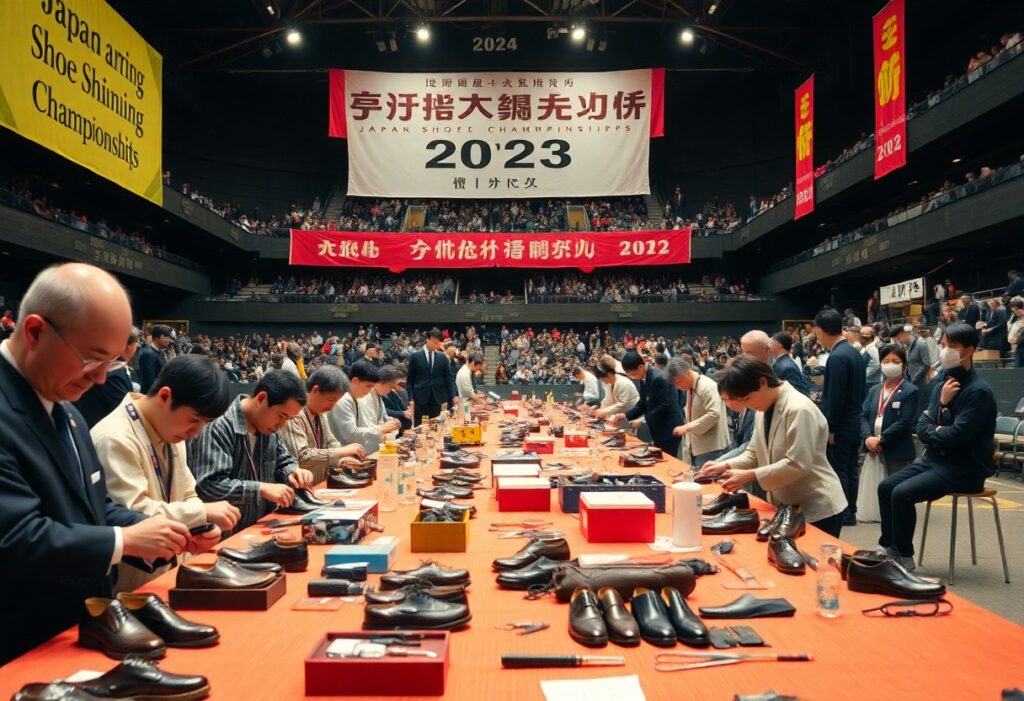
The 2024 Japan Shoe Shining Championships turned Osaka into a showcase for elite shoe care, with Ryu Niita of Brift H Aoyama taking the title. The event brought together 64 contestants, a strict 20-minute format, and a judging split that rewarded both finish and presentation.
Event Snapshot
| Event | Japan Shoe Shining Championships 2024 |
| Host city | Osaka, at Hankyu Umeda department store event hall |
| Entrants | 64 contestants |
| Format | Qualifiers in Fukuoka and Tokyo, then semi-finals and finals in Osaka |
| Winner | Ryu Niita, Brift H Aoyama |
| Judging split | 80% shine quality and beauty, 20% presentation |
What Made The Event Notable
- Contestants had just 20 minutes to shine a full pair of shoes.
- Finalists also had 45 seconds to present their work to judges.
- The finals tested two very different leather types in back-to-back rounds.
- Only four finalists advanced to the final stage in Osaka.
If you want broader context on how serious shoe care workflows are built, see our guide to choosing the right shoe brush. It is a practical follow-up to the judging emphasis on technique, finish, and control.
How The Championships Worked
The 2024 championship used a three-stage structure built to narrow a large field into a small final group. Two qualification rounds were held first, one in Fukuoka and one in Tokyo, with 32 contestants at each location. The top eight performers from each round advanced to the Osaka finals, which brought the field down to the strongest technicians in the competition.
That setup mattered because the event was not only about speed. Contestants had to show disciplined preparation, control over product application, and enough stage presence to make their process legible to judges and spectators.
Qualification Rounds In Fukuoka And Tokyo
The preliminary rounds were first-come, first-served, so registration timing was part of the challenge before the competition even began. Each city hosted 32 entrants, and the eight strongest performers from each venue moved forward. That created a balanced final group while rewarding not only skill but also the ability to handle pressure early in the process.
The Osaka Finals
The final stage took place at Hankyu Umeda’s event hall in Osaka and pushed contestants through semi-finals, a repechage round, and the championship final. In the decisive round, competitors had to shine two distinct pairs: black Shell cordovan plain toe derbies and burgundy museum calf wingtip double monk straps. Each round allowed 20 minutes for the shine itself, followed by a 45-second presentation to the judges.
That combination made the competition unusual even by professional standards. Shell cordovan and museum calf behave differently under polish, so the final round rewarded contestants who could adapt their method instead of repeating a single approach.
Products, Technique, And Judging
The competition required contestants to work within a standardized product system, using conditioner, shoe cream, and wax polish from four approved brands. That format helped keep the playing field fair, but it also made product choice part of the strategy. Competitors had to decide how to combine care, color depth, and finish within a narrow time window.
Judging was split 80/20 between shine quality and presentation. The larger share went to technical execution: even application, depth of shine, leather conditioning, and overall visual balance. The smaller share still mattered, because contestants had only 45 seconds to explain what they had done and why. In a field like this, clarity and confidence were part of the performance.
For readers interested in the care side of the craft, a well-shaped pair starts long before polish goes on. Our guide to shoe trees, their benefits, and how to choose them is a useful companion piece because the same attention to structure and maintenance shows up in high-level shoe shine work.
The Finalists And The Winning Pair
The final four reflected the strength of Japan’s professional shoe care scene. Naoki Ueda represented Penny Lane Shoe Shine Boys, Ryu Niita represented Brift H Aoyama, Genta Saito came from Ginza Shoe Shine Shop, and Teroyushi Tomigashi represented GMT Factory. The lineup made the final round feel less like a novelty event and more like a genuine showcase of specialist craftsmanship.
Ryu Niita emerged as the 2024 champion after handling both final challenges with control and consistency. His win stood out because the championship asked for more than a glossy surface. The judges were weighing product judgment, leather knowledge, speed, presentation, and the ability to adapt across two very different pairs of shoes.
That mix is what gives the event its appeal. It is not simply a contest for the brightest finish; it is a test of professional decision-making under pressure. The winner had to make the right calls quickly, then explain them clearly.
Why This Championship Matters
The 2024 event showed how far shoe shining has evolved as a specialist craft. It combined technical precision, leather-specific knowledge, and public presentation in a format that made each competitor prove the full range of their skill.
It also reinforced Japan’s reputation as a global center for professional shoe care. From the regional qualifiers to the Osaka final, the structure rewarded craft, speed, and judgment rather than simple spectacle.
Keep Reading
If this event report sparked an interest in the tools behind polished results, the next most relevant read is our guide to choosing the right shoe brush. It is a practical place to continue from the competition’s emphasis on finish quality and control.
For readers who want the maintenance side of the story, the shoe tree guide above is the best companion piece.
Frequently Asked Questions
Who Won The Japan Shoe Shining Championships 2024?
Ryu Niita of Brift H Aoyama won the 2024 championship in Osaka.
How Was The Competition Structured?
The event began with qualification rounds in Fukuoka and Tokyo, each with 32 contestants, and the top eight from each location advanced to the finals in Osaka.
What Did Judges Score Most Heavily?
Judges gave 80% of the score to shine quality and beauty, with the remaining 20% based on presentation skills.
What Shoes Were Used In The Final Round?
Finalists worked on black Shell cordovan plain toe derbies and burgundy museum calf wingtip double monk straps, each within a 20-minute time limit.

Ethan Marshall is a passionate writer and content creator at My Shoes Finder, where he explores a diverse range of topics, from lifestyle and fashion to innovative products and personal development. With a keen eye for detail and a commitment to delivering engaging and informative content, Ethan connects with readers by sharing insights that inspire and inform. He believes in the power of storytelling to influence positive change, and he continually seeks to provide valuable perspectives that resonate with his audience.
See also:
 Neutral Wax On Shoes: When To Skip It And What To Use Instead
 Choosing The Right Shoe Brush: Types, Materials, And Best Uses
 Should You Condition New Shoes? Here’s When To Wait
 How To Remove Candle Wax From Leather Shoes Safely
 How To Darken Shoe Color With Cream: Safe Tips For A Polished Finish
 Why Waterproofing Spray Can Ruin Smooth Leather Shoes



It’s fascinating to see the shoe shining competition elevate to such a significant event in Japan, particularly how it intertwines tradition with modern competition dynamics. The time constraint of 20 minutes for a full shine is truly a testament to the contestants’ technical prowess and dedication to their craft. It’s not just about the visual appeal of the shoes but also the precision and skill that go into achieving that shine within such a limited timeframe.
It’s incredible how much depth there is in something as seemingly simple as shoe shining. The connection between tradition and modern competition really opens up a conversation about craftsmanship and the value we place on skills that might often go overlooked in today’s fast-paced world.
You’ve captured something really important there—the interplay between tradition and modernity in crafts like shoe shining is fascinating. It’s easy to overlook how much skill and care goes into something that seems simple. I find it interesting how, in our fast-paced world, many of these traditional skills are undervalued, yet they carry so much history and meaning.
I must admit, I had no idea the world of shoe shining was so intricate and competitive! The Japan Shoe Shining Championships in Osaka sound like an incredible event. It’s fascinating how something as seemingly simple as polishing shoes can evolve into a showcase of skill, precision, and artistry.
It’s interesting how easy it is to overlook the craft behind things we take for granted. The Japan Shoe Shining Championships really highlight the dedication and precision involved. It’s not just about making shoes look good; it’s a form of personal expression and a way to preserve an image, whether for business or personal style.
It’s interesting, isn’t it? Most people overlook shoe shining as just a mundane chore, but there’s this whole world behind it that reflects a lot about culture and personal expression. The Japan Shoe Shining Championships really highlight that. What might seem like a simple act can actually reveal so much about dedication, skill, and craftsmanship.
It’s fascinating to see how a seemingly niche skill like shoe shining can evolve into such a competitive and celebrated event! The three-stage format really highlights the dedication and expertise of the contestants. Ryu Niita must have demonstrated incredible precision and artistry to come out on top in such a prestigious setting.
It’s interesting how diving into something as seemingly simple as shoe shining can reveal layers of skill and passion that aren’t immediately obvious. You’re spot on about Ryu Niita; his approach reflects years of practice and a keen eye for detail. But let’s unpack this a bit further.
It’s intriguing how many people overlook the artistry involved in shoe shining until they see it taken to this level. Ryu Niita’s precision isn’t just about polishing; it’s about understanding the materials, the techniques, and the history behind each shoe. What’s really fascinating is how such a traditional skill has transformed into a competitive arena, pushing competitors to elevate their craft.
It’s fascinating to see the increasing prominence of events like the Japan Shoe Shining Championships, especially as they exemplify the blend of tradition and modern competition. Ryu Niita’s victory must have been well-deserved, given the stringent time and quality requirements you mentioned.
You bring up a great point about the blend of tradition and modern competition in events like the Japan Shoe Shining Championships. It’s interesting to see how something as simple as shoe shining has evolved into a competitive art form. Ryu Niita’s approach combines skill, speed, and a deep respect for the craft, which really sets him apart.
Your detailed overview of the 2024 Japan Shoe Shining Championships offers a fascinating glimpse into a niche yet culturally rich aspect of craftsmanship that often goes unnoticed in the broader conversation about fashion and personal care. It’s intriguing to consider how a seemingly simple activity like shoe shining can evolve into such a high-stakes competition, reflecting larger themes about mastery, tradition, and the value we place on meticulousness in our everyday lives.
It’s refreshing to hear your appreciation for the 2024 Japan Shoe Shining Championships. It’s one of those fascinating intersections where art and practicality meet, isn’t it? The tradition behind shoe shining is rich with history, and when you watch competitors take to the stage, there’s a palpable sense of respect for the craft.
It’s interesting you mention the evolving nature of shoe shining as a craft. When we think about it, there’s something almost meditative about the process—taking the time to care for something that often gets overlooked in our fast-paced lives. In Japan, the meticulous attention to detail in craftsmanship extends beyond shoe shining to a rich tapestry of traditions that emphasize quality and respect for materials.
This post really highlights the artistry involved in shoe shining, which often goes overlooked in our fast-paced world. It’s fascinating to see how a simple task can evolve into a competitive sport where precision and creativity meet. I think it also reflects a larger cultural appreciation in Japan for craftsmanship and attention to detail, which often surfaces in various art forms, from tea ceremonies to calligraphy.
You’ve brought up an interesting point about the artistry in shoe shining, and it’s true that it’s often overshadowed in our hurried lives. The transformation of what many see as a mundane task into something that embodies competition and skill is quite remarkable.
You know, it’s funny how we often take the simplest things for granted—shoe shining included. It’s like the unsung hero of the grooming world, right? We’ve got people running marathons to keep fit, but how about the true athletes who take a pair of scuffed shoes and turn them into something that sparkles like they just stepped off the runway? The finesse they apply is nothing short of a competitive sport.
It’s fascinating to see how a seemingly simple activity like shoe shining can escalate into such a competitive and intricate event. The Japan Shoe Shining Championships not only highlight the craftsmanship involved but also reflect a broader cultural appreciation for meticulousness and attention to detail that is prevalent in Japanese society. The requirement for contestants to showcase their skills under such strict time constraints emphasizes the combination of speed and precision required in professional shoe care.
You bring up such an interesting point about the Japan Shoe Shining Championships. It’s amazing how this competition transcends simple shoe care and becomes a celebration of craftsmanship. It really showcases how every aspect of Japanese culture—whether it’s tea ceremonies or this shoe shining event—emphasizes precision and meticulousness.
You really hit the nail on the head with that observation. It’s interesting to think about how something as ordinary as shoe shining can transform into a competitive sport. The craftsmanship involved really is remarkable, and it’s cool to see how it blends artistry with skill.
The Japan Shoe Shining Championships provide a fascinating glimpse into a craft that is often overlooked in our fast-paced modern society. It’s intriguing to see how shoe shining, which might seem like a simple task, can evolve into a competitive art form that values not only skill but also creativity and presentation. The rigorous three-stage format and qualifications that participants must navigate speak volumes about the commitment and expertise required in this field.
You’re spot on about the Japan Shoe Shining Championships highlighting a craft that many people overlook. It really is interesting how something as apparently simple as shoe shining can be transformed into a serious form of artistry. Each participant brings their unique flair to the table, whether it’s through their choice of materials, the techniques they use, or the way they present their finished work.