
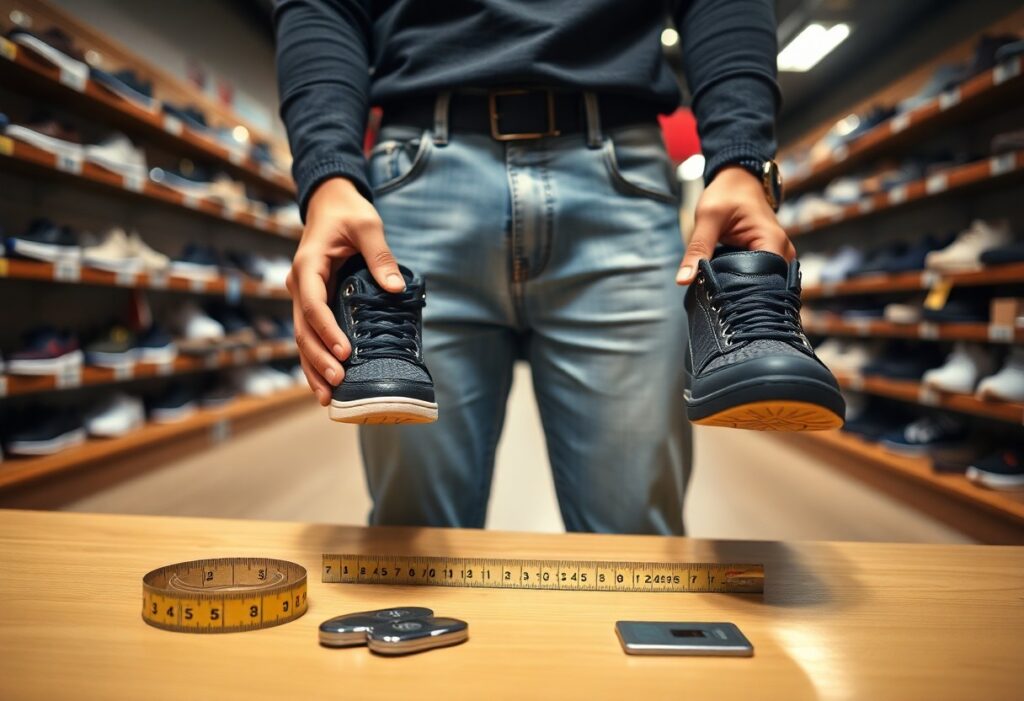
If one foot is larger than the other, the cleanest way to shop is to fit the larger foot first and then fine-tune the looser shoe. That approach prevents toe crowding, heel slip, and the kind of daily discomfort that turns a simple purchase into a mistake.
For a fuller buying framework, pair this guide with the main uneven-foot buying guide, then use the tactics here to narrow the fit on the shop floor or after delivery.
Best-fit approach for uneven feet
- Measure both feet later in the day, when they are closest to their real-world size.
- Buy to the larger foot, then correct the smaller side with volume reducers, pads, or a thicker sock.
- Ask about split sizes before you settle for a pair that compromises comfort.
- Use custom or modified solutions only when standard sizing cannot give both feet enough room.
The Simplest Decision Map
Most shoppers with uneven feet do not need a complicated system. They need the right sequence: confirm the size difference, choose the larger foot as the anchor, then decide whether the smaller foot can be managed with an insert or whether the shoe itself needs a different size.
| Fit strategy | Best for | Pros | Trade-off |
|---|---|---|---|
| Buy to the larger foot | Small to moderate size differences | Protects the foot most likely to feel pain first | The smaller side may need extra volume control |
| Split sizes | Noticeable size mismatch | Balances both feet more precisely | Availability is limited at many retailers |
| Inserts and padding | One foot slips in the larger shoe | Affordable and easy to adjust | Works best when the size gap is not extreme |
| Custom or modified shoes | Persistent fit problems or special needs | Most precise long-term solution | Higher cost and less convenience |
Start With The Right Measurement, Then Shop With A Plan
Measuring both feet is still the first step, but the goal is not just to collect numbers. It is to spot how much difference you are actually working with and whether the gap is small enough for inserts or large enough to justify split sizing or specialty help.
Measure while standing and do it at the end of the day, when your feet are typically a touch larger. Capture length, width, and anything that affects volume, such as a high instep. If you have not compared shoe size notes before, it can also help to review the signs of a proper shoe fit so you know what to check once the shoe is on your foot.
The practical rule is simple: the larger foot sets the baseline. If the larger foot is cramped, no amount of padding on the other side will make the shoe comfortable. If the larger foot fits and the smaller foot feels loose, you still have room to improve the fit without restarting the whole purchase.
What To Try In A Store
- Try both shoes on, not just the larger foot.
- Walk on a firm floor for a few minutes to test heel hold and toe space.
- Check whether the smaller foot needs a thinner sock, a tongue pad, or a simple insert.
- Ask whether the retailer can order two different sizes or sell mixed-size pairs.
Where The Fit Usually Succeeds — And Where It Fails
Traditional shoe shopping works best when the size difference is modest and the shoe has some built-in adjustment. Lace-up styles, shoes with removable insoles, and roomier uppers usually give you more flexibility than stiff, narrow, or highly structured models.
Specialty stores can be worth the trip when the mismatch is more obvious. They are more likely to understand split sizing, width differences, and comfort modifications, and they can often point you toward brand lines that run wider or offer better internal volume. If you are comparing brand-level fit information, the broader size guide for better shoe fit can help you translate general measurements into real purchases.
When stores only sell matched pairs, the question becomes whether the smaller foot can be adapted safely. That is usually where removable insoles, heel grips, tongue pads, or modest padding solve the problem without forcing you into a completely different shoe.
When Split Sizes Are Worth Asking For
Split sizes make the most sense when one foot is consistently half a size or more larger than the other and standard sizing leaves the larger foot short on room. They are especially useful if you wear the same style often and want a dependable solution instead of constantly adjusting inserts.
The drawback is availability. Many shops do not advertise split sizing upfront, so it helps to ask directly before you commit to a pair. A quick question at the fitting stage can save you from settling for a shoe that technically fits but never feels right.
Comfort Fixes That Solve Most Everyday Problems
For a lot of shoppers, the best solution is not a special-order shoe. It is a well-chosen standard shoe with a few quiet adjustments. This is where the article shifts from sizing theory to shopping workflow: once the larger foot is safe, you can work on keeping the smaller foot stable.
Low-friction adjustments that help quickly
- Use a volume-filling insole or heel grip in the larger shoe.
- Try thicker socks on the smaller foot only if the shoe still bends naturally.
- Add padding in small steps; too much filler can create pressure points.
- Choose removable insoles when possible so you can fine-tune the fit later.
If the size difference creates sliding, blisters, or heel lift even after basic adjustments, professional shoe repair is the next logical step. A skilled cobbler can stretch, pad, or lightly modify a pair so it behaves more like a custom fit without forcing you into full bespoke pricing.
That said, modifications should support the shoe, not fight it. If the larger foot is already under pressure, modifications to the smaller side will only mask the real problem. In that case, the better decision is to change the size strategy rather than keep rescuing the wrong pair.
When Custom Shoes Are The Right Call
Custom or made-to-order shoes are not the first answer for most shoppers, but they can be the cleanest answer when the mismatch is pronounced or when you have recurring pain from standard sizing. They are also worth considering if your feet differ not only in length but also in width, volume, or arch shape.
The upside is accuracy. The downside is cost, wait time, and fewer style options. For occasional wear, that may be too much. For an everyday pair that you will depend on constantly, the investment can pay back in comfort and fewer fit compromises.
If you are already comparing exact-fit resources or considering other sizing-focused purchases, the broader universal sizing guide is a useful companion page for translating fit notes into a practical order decision.
Ready to choose the next step?
If you want the broader buying strategy, start with the main guide to buying shoes for uneven foot sizes. If you already know your measurements, use this page to decide between split sizing, inserts, or a custom order.
The best result is usually the one that protects the larger foot first and keeps the smaller foot stable without forcing the whole pair to work against your gait.
A Short Practical Checklist Before You Buy
- Know the size difference between feet before you shop.
- Try shoes later in the day, not first thing in the morning.
- Fit to the larger foot even if the smaller one feels less snug.
- Look for removable insoles, lacing room, and enough toe space.
- Ask about split sizing before you assume it is unavailable.
- Use inserts or padding only after the larger foot fits correctly.
Frequently Asked Questions
How Do I Measure My Feet Correctly When They Are Different Sizes?
Measure both feet while standing and ideally at the end of the day. Record length and width for each foot, then use the larger foot as your shopping baseline. That gives you the safest starting point and makes inserts or padding easier to plan.
What Can I Do If One Foot Is Significantly Larger Than The Other?
Ask about split sizes first, then test whether a standard pair can be adjusted with inserts, heel grips, or padding. If the larger foot is still cramped, move up to a different size or consider custom options rather than forcing the fit.

Ethan Marshall is a passionate writer and content creator at My Shoes Finder, where he explores a diverse range of topics, from lifestyle and fashion to innovative products and personal development. With a keen eye for detail and a commitment to delivering engaging and informative content, Ethan connects with readers by sharing insights that inspire and inform. He believes in the power of storytelling to influence positive change, and he continually seeks to provide valuable perspectives that resonate with his audience.
See also:
 How To Buy Shoes When One Foot Is Bigger: Fit Tips That Actually Help
 Apron Front Vs Split Toe Seams: What They Are And How To Spot Good Craftsmanship
 Xero Shoes With Custom Orthotics: 2025 Compatibility Guide
 Nubuck Vs Suede Vs Roughout Leather: Differences, Care, And Best Uses
 Widest Xero Shoes for Wide Feet: Models & Fit Guide
 How To Make Feet Look Smaller With Stylish Shoes



Ah, the eternal struggle of uneven feet! I can relate—I’ve got one foot that seems to have received an extra splash of growth serum in the night while the other decided to take the “stay small” option. It’s like my feet are in a constant competition to see which can be more of a nuisance!
It’s so interesting how our bodies can throw us these little curveballs, isn’t it? Your description of your feet in a competition made me chuckle; I can totally picture it. It’s really a unique struggle that many people don’t often talk about, and it feels like we have to navigate these daily challenges that can affect how we feel in our own skin.
It really is fascinating how our bodies can keep us on our toes, sometimes literally. I think your comment about feeling like we have to navigate daily challenges resonates deeply with so many people. Those little struggles can show up in ways we don’t often expect, just like my foot situation during competition. It’s funny how something as basic as our feet can impact our confidence and performance.
It’s true, our bodies have a way of reminding us just how interconnected everything is—each little struggle can feel magnified during important moments. I can relate to that feeling of being thrown off by something seemingly small; it’s like the body has its own agenda that can change how we feel in an instant. When I was preparing for a big presentation once, I had a nagging shoulder issue that made it hard to focus. It’s interesting how those physical sensations can alter our confidence and change our performance entirely, even if it’s something as basic as making sure our feet are comfortable.
I totally get that—it’s surprising how much our feet can influence our daily lives, so I found this guide on finding the right shoes for uneven sizes really helpful; it might be just what you need to tackle those unexpected challenges.
‘Tips for buying shoes when your feet are different sizes finding the perfect fit’
https://myshoesfinder.com/buying-shoes-for-uneven-foot-sizes-tips/.
It really is fascinating how our bodies can surprise us, isn’t it? It’s like they have their own agenda sometimes. When I was preparing for a recent competition, I noticed my feet were not just tired but also had their own little quirks. It’s something that could easily be overlooked, but those physical discomforts really do shape our experiences.
It’s interesting how our bodies do seem to have their own quirks and preferences, especially when we’re pushing them to the limit. During competitions, it’s like a whole new world of sensations opens up. Your feet, in particular, can communicate so much about how we’re feeling—whether they’re sore, cramped, or just not quite cooperating. These little signals provide insights into our overall well-being and readiness, which is easy to overlook.
It really is fascinating how our bodies work in such unexpected ways, isn’t it? I can relate to that struggle you mentioned; the little quirks we experience can sometimes feel like they define our day. I’ve had my own share of those moments, particularly during a race when I felt like my feet had a mind of their own, completely disregarding everything else I was focused on. It’s kind of funny when you think about it—like our bodies have their own agenda.
I totally get that. It’s like our bodies have their own quirky personalities sometimes, isn’t it? I’ve noticed that my left foot is slightly wider than my right, which not only complicates shoe shopping, but also makes me think about how much we take for granted in terms of our body’s symmetry.
I totally get that foot rivalry—you might find some handy tips in this article that helped me tackle the shoe shopping struggle when dealing with different sizes.
‘Tips for buying shoes when your feet are different sizes finding the perfect fit’
https://myshoesfinder.com/buying-shoes-for-uneven-foot-sizes-tips/.
I totally get what you mean about the “competitive” nature of our feet. It’s almost comical how one foot can have a mind of its own. I’ve got a similar situation, and sometimes it feels like I’m struggling to find shoes that accommodate both sides. It makes shoe shopping feel a bit like a game—trying on pairs that fit one foot perfectly while the other feels like it’s in a vice.
It sounds like you have quite the lively competition happening with your feet! It’s interesting how something as simple as foot size can have such a quirky impact on our daily lives. It’s those little challenges that remind us of our uniqueness, right?
It’s true—our feet often seem like the unsung heroes of our day-to-day lives, and yet they can be a source of such quirky competition. I’ve definitely noticed how something as seemingly trivial as foot size can shape experiences, like finding the perfect pair of shoes. I’ve had my fair share of frustrating shopping trips where everything stylish seems to be designed for smaller sizes. There’s this stereotype about how women’s shoes are often pegged to be more delicate and fashionable, but finding a comfortable fit can sometimes feel like a total scavenger hunt.
It’s funny how something as simple as finding the right shoe size can turn into a little adventure—I’ve come across some helpful tips that might just help keep that lively competition in check!
‘How to know if you’re wearing the right shoe size signs and tips for a perfect fit’
https://myshoesfinder.com/signs-and-tips-for-the-right-shoe-size/.
This topic resonates deeply with me, as I’ve often grappled with the challenge of finding well-fitting shoes due to having one foot that’s a half size larger than the other. It’s astonishing to think that over 60% of people experience this issue, and yet, it remains an under-discussed topic in the realm of footwear. Your point about measuring both feet accurately is crucial; I remember the first time I took both measurements seriously, and it completely transformed my shoe shopping experience.
This post really resonates with me. I’ve often struggled with finding shoes that accommodate my uneven feet, and it’s so easy to overlook the importance of proper measurements. I had a pair of shoes that I loved but ended up causing blisters because one foot was snug while the other was loose. It’s amazing to think that such a common issue affects over 60% of us!
It’s interesting how something as seemingly simple as shoe fit can have such a big impact on our daily comfort. Your experience with blisters really highlights how important proper measurements are, especially since so many of us have uneven feet. I actually stumbled upon some research recently that mentioned different foot shapes and how brands often design shoes around a “standard” size, which can leave a lot of us struggling to find the right fit.
I really appreciate how you highlighted the issue of uneven feet—it’s something many people overlook when they think about shoe shopping. I remember struggling with this myself and finding out that not only do I have different foot sizes, but my wider foot often leads me to compromise on comfort just to find a decent fit. Measure at the end of the day is such great advice; I never thought about how swelling could affect the size!
Ah, the eternal struggle of the uneven-footed! I never thought my feet would spark such a passionate journey in footwear. I mean, who knew that shoe shopping could feel like a twisted game of “one size fits one” where I’m the unwitting contestant? I’ve found myself in stores trying on shoes that feel just right on one foot while my other foot is throwing a full-on tantrum, demanding to be heard.
This post brings up a topic that resonates with many of us, especially those who frequently face the challenge of finding well-fitting shoes. I’ve always found it perplexing that size discrepancies can be such a common issue, yet shoe shopping remains largely uniform across brands and styles. It raises a few critical points that are often overlooked in the general discourse around footwear.
This topic resonates with many of us who have faced the challenge of finding suitable footwear. I’ve personally struggled with finding shoes that accommodate my uneven feet, which often leads to discomfort during long wear. The suggestion to measure our feet accurately—particularly at the end of the day when they’re slightly swollen—makes a lot of sense.
I can completely relate to the struggle of finding the right shoes, especially when you have uneven feet. It’s interesting how often we overlook the importance of fitting footwear properly. I often find that shoes that feel comfortable in the morning can turn into a source of discomfort by afternoon—especially when they’ve been tailored for a more “standard” foot shape.
Finding the right shoes can be quite the ordeal, especially when dealing with uneven feet. Your experience sheds light on a common issue many face. It’s interesting how our feet can change throughout the day; measuring them later in the day when they’re a bit swollen often reveals more accurate sizing for comfort.