
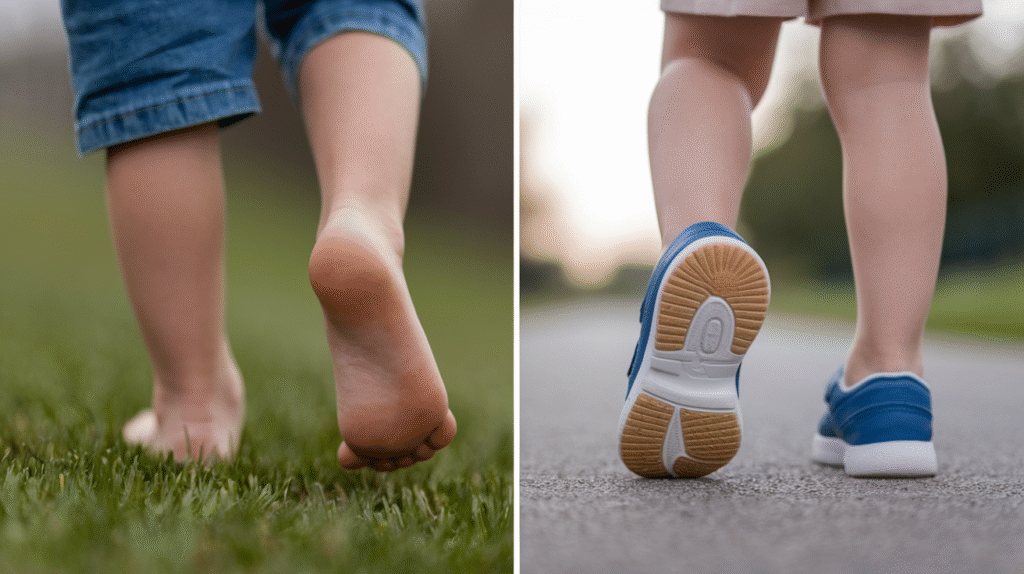
Children’s feet change quickly in the early years, and footwear can either leave that growth alone or interfere with it. For parents, the real question is not whether barefoot is always best, but when barefoot time helps and when a well-fit shoe is the safer choice.
What most parents need to know
- Barefoot Time can support natural toe splay, balance, and foot muscle use at home and on safe surfaces.
- Minimalist Shoes are often the best middle ground when children need protection but still benefit from flexibility.
- Conventional Shoes are still useful for rough ground, weather, school rules, and activities that need more protection.
- Fit Matters More Than Brand: a wide toe box, flexible sole, and enough length for growth are the biggest priorities.
If you want the broader footwear context first, start with these barefoot foot-health basics, then come back to the child-specific fit and development details here.
The strongest evidence from pediatric biomechanics points to a simple idea: children generally do better with more freedom at the toes, enough room for growth, and less unnecessary stiffness. That does not mean every child should be barefoot all day, but it does mean a shoe should serve the foot rather than reshape it.
How Child Foot Development Changes With Footwear
In early childhood, the foot is still forming its arch, refining toe alignment, and building strength through movement. When a child has room to spread the toes and feel the ground, the small muscles of the foot do more work. That can support balance and help movement look more natural during walking and play.
The original research summary behind this page pointed to a few useful patterns: children who spend more time barefoot or in minimalist footwear often show higher arch measurements, less midfoot loading, and more natural toe alignment than children who are always in conventional shoes. Those findings do not prove that every barefoot moment changes structure permanently, but they do support the practical idea that constant restriction is not ideal during growth.
If you are comparing shoes for a toddler specifically, the most practical companion guide is this toddler barefoot-shoe guide, because fit and daily use matter just as much as theory.
What Changes By Age: Toddler, Preschool, And School-Age
Toddlers
Toddlers benefit most from freedom to stand, grip, and balance. If shoes are needed outdoors, look for a wide toe box, a flexible sole, and a secure heel that does not squeeze the forefoot.
Preschoolers
This is the stage when play gets more intense and shoe fit starts to matter more. Many children can use minimalist shoes well if they still have room for toe splay and enough sole flexibility for running, climbing, and squatting.
School-Age Children
By school age, the decision is often about activity and environment. Sports, playgrounds, classroom rules, and weather may all require more protection, but the shoe should still leave the forefoot roomy and avoid unnecessary stiffness.
When Barefoot Time Helps, And When Shoes Are The Better Choice
Barefoot time is most useful when the goal is natural movement practice in a low-risk setting. Indoors, on clean flat ground, and during supervised play, it gives the foot a chance to move without being boxed in. That can support arch use, toe function, and body awareness.
Shoes become the better choice when the environment adds risk. Hot asphalt, broken ground, wet public areas, winter conditions, playground surfacing, and sports all justify protection. A child does not lose developmental benefit just because they wear shoes sometimes; the problem is when every shoe is so tight, stiff, or narrow that the foot never gets room to work.
The same logic is why the transition matters. If a child has spent years in more structured shoes, a sudden shift to very thin soles can feel awkward or tiring. A more gradual approach usually works better, which is why a gradual barefoot-shoe transition is often the safer path than an all-at-once switch.
A practical parent rule
Choose the least restrictive shoe that still fits the task. For everyday wear, that usually means a flexible shoe with a roomy toe box. For safe time at home, barefoot is often fine. For harsh conditions, protection wins.
What To Look For In A Child’s Shoe
The original article spent a lot of time on biomechanics, but parents usually need a shorter checklist. Focus on fit first, then flexibility, then protection.
- Room At The Toes The front should not pinch or tilt the big toe inward.
- Enough Length Children need growth room without the foot sliding around.
- Flexible Sole The shoe should bend where the foot bends, not fight the step.
- Lightweight Materials Heavy shoes can make movement feel clumsy for small children.
- Secure But Not Tight Fit The shoe should stay on without squeezing the forefoot.
If you want a broader explanation of barefoot-style footwear and why it behaves differently from conventional shoes, this barefoot walking overview is a useful companion read.
When To Be More Cautious
Most children do not need aggressive arch support just because they have flat-looking feet in the early years. However, a child who has pain, frequent tripping, obvious asymmetry, or a shoe fit problem that keeps returning should be assessed by a pediatric clinician or podiatry professional. Footwear is one part of the picture, not the entire diagnosis.
That caution matters because the strongest takeaway from the research is not that every shod child is harmed. It is that poorly chosen shoes can interfere with natural movement during a time when the foot is still learning how to bear load efficiently.
Where to go next
If your goal is to build a healthier shoe rotation for your child, start with the general barefoot benefits page for the movement basics, then use the toddler guide for fit details and age-appropriate choices.
Read next: barefoot foot-health basics and podiatrist-approved toddler shoe guidance.
Frequently Asked Questions
Are Barefoot Shoes Good For Children?
They can be, especially when the shoe has a wide toe box, a flexible sole, and a secure fit. They are most useful when a child needs protection but still benefits from natural movement.
Should Children Walk Barefoot All The Time?
No. Barefoot time is helpful in safe settings, but shoes are still important for weather, rough surfaces, school, and sports. The best approach is usually a mix of both.
What Shoe Shape Is Best For A Child’s Foot?
A shoe with a roomy forefoot, enough length, and a flexible sole is usually the best starting point. The toe box should not force the big toe inward or compress the smaller toes.

Ethan Marshall is a passionate writer and content creator at My Shoes Finder, where he explores a diverse range of topics, from lifestyle and fashion to innovative products and personal development. With a keen eye for detail and a commitment to delivering engaging and informative content, Ethan connects with readers by sharing insights that inspire and inform. He believes in the power of storytelling to influence positive change, and he continually seeks to provide valuable perspectives that resonate with his audience.
See also:
 Xero Shoes For Children In 2025: Fit, Safety, And Best Models
 KIDS
KIDS
 Xero Shoes For Kids: Are They Safe, And When Do They Make Sense?
 Barefoot Shoes For Kids: Benefits, Risks, And How To Choose
 Are Barefoot Shoes Good For Teachers? A Practical Classroom Fit Guide
 Best Barefoot Shoes For Teachers: All-Day Comfort In The Classroom

I really appreciate how you’ve highlighted the importance of footwear choices in pediatric foot development. It’s such an interesting topic, especially as more parents are becoming aware of the long-term implications of shoe design on their children’s health.
It’s encouraging to see so much interest in how our footwear choices can impact children’s foot development. The awareness among parents is definitely growing, and that’s a positive sign for the next generation’s health.
Footwear choices really do play a crucial role in pediatric foot development, don’t they? It’s fascinating how something as seemingly simple as shoes can have such a lasting impact on both physical health and overall well-being. I’ve noticed that many parents today are much more mindful about this topic compared to past generations.
You bring up a really important point about footwear choices and their broader implications for children’s health. It’s interesting to see how our understanding of pediatric foot development has evolved over the years. Back in the day, shoes were often chosen more for style or convenience than for the actual needs of growing feet. Today, though, there’s a greater awareness among parents about how crucial it is to find the right fit and support for their little ones.
You’ve touched on a really crucial point. Many parents might not realize how their little ones’ shoes can affect more than just comfort. It’s fascinating to see how the wrong footwear can influence things like posture and balance as they grow. There’s also that balance between style and support that’s tricky to navigate. Have you come across any brands that seem to hit that sweet spot? It’s really all about making informed choices as they grow up.
Your exploration of the intricate relationship between footwear and pediatric foot development raises some compelling points, particularly regarding how the choices we make for our children’s footwear can influence their long-term health. As I’ve delved into this topic with my own children, it’s become increasingly clear to me that the narrative around shoes—especially regarding those that promote a more natural foot position—deserves greater attention in public discourse.
This topic truly resonates with me as a parent who has navigated the often overwhelming world of footwear choices for my child. I can wholeheartedly relate to the implications you’ve outlined regarding how shoes can influence foot development. I remember when my child first started taking those tentative steps; I was so caught up in finding the “perfect” pair of shoes that I overlooked the idea of letting them explore barefoot or in minimalist footwear.
It’s interesting how many parents find themselves in the same boat regarding footwear choices. The pressure to choose the right shoe can feel immense, especially when you think about your child’s developing feet and their overall comfort. It’s easy to get caught up in the pursuit of what seems like the “perfect” pair, often driven by marketing messages rather than what’s actually beneficial for foot development.
It’s great to hear that this topic resonates with you! Footwear decisions can feel like a maze, especially when we’re just trying to ensure our little ones have the best start. That moment when they first hesitate and then take those brave steps is both exciting and nerve-wracking. It’s interesting to think how much pressure we put on ourselves to find that “perfect” shoe.
This post resonates deeply with me as both a parent and someone who has taken a keen interest in the intricacies of child development. It’s remarkable how something as seemingly simple as footwear can have such far-reaching effects on our children’s growth and well-being. The connection between footwear choices and foot morphology is a concept that has only recently come to the forefront of pediatric health, yet it is fundamental in shaping our understanding of not just foot health, but overall physical development.
You’re spot on about the impact of footwear on kids’ growth and development. It’s fascinating to think that something we often overlook can play such a pivotal role. Shoes are more than just a fashion statement; they actually influence how our children’s feet develop, which can affect their posture, balance, and even long-term musculoskeletal health.
I completely agree with you about the impact of footwear on kids’ growth and development. It’s interesting to think how many parents might not realize that a good pair of shoes can have such a significant effect on their child’s posture and balance. I remember reading a study that highlighted how improper footwear could lead to long-term issues like flat feet or even back problems later in life.
I found your exploration of pediatric foot development and the impact of footwear choices to be particularly enlightening. As a parent, I’ve often grappled with the overwhelming variety of shoe options available for children, each promising comfort and support. Your point about how shoes can significantly affect foot morphology really struck a chord with me. It’s fascinating to think about how a seemingly simple decision like shoe selection can lead to profound implications for a child’s long-term health.
It’s interesting to see how footwear can impact children’s foot development. I remember when my son was a toddler, and I always focused on getting him cute shoes instead of thinking about what was actually good for his feet. Once I learned about the benefits of barefoot experiences, I started letting him play outside bare foot more often. It was surprising to see how much more confident he became while running and climbing. It’s fascinating how something as simple as the shoes we choose can shape their overall physicality. I wonder if more parents are starting to realize this connection and what changes they’ve made. Have others noticed any changes in their kids’ movement or comfort with different types of shoes?
It’s great to hear about your journey with your son and how adopting a barefoot approach has positively influenced his confidence and movement. Many parents can relate to the initial focus on style over function when it comes to buying shoes for their little ones; it’s easy to get drawn in by those adorable designs. However, your experience really highlights an important shift that more parents seem to be embracing—recognizing that the right kind of footwear, or even opting for no shoes at all, can play a significant role in a child’s development.
This topic is incredibly relevant and highlights a critical yet often overlooked aspect of childhood development. As a parent, I’ve been particularly mindful of my children’s footwear since learning about the significance of foot health. It’s surprising how many parents may not realize that the shoes we choose can impact everything from arch formation to overall posture.
It’s great to hear that you’re so mindful of your children’s footwear. Many parents don’t connect the dots between shoes and long-term health. Choosing the right shoes can influence more than just style; it lays the foundation for their development.
It’s true, the connection between footwear and long-term health is something many overlook. I’ve been increasingly aware of how critical the right shoes are, especially as my kids grow and their feet change. I have noticed that poor footwear can affect not just comfort but also posture and even their overall confidence when they’re running around.
I found your insights on how footwear can shape a child’s foot development super interesting! It’s wild to think about how something as simple as shoes can have such a profound effect on things like arch formation and gait. I’ve really started to take a closer look at my kids’ shoes lately, especially after reading about the benefits of minimalist footwear.
It’s fascinating to see how much attention you’re giving to your kids’ footwear. I’ve read similar studies about the impact shoes can have on a child’s foot development, and it’s surprising how easily it can be overlooked. The difference between traditional shoes and minimalist options really can change the way a child interacts with their environment and moves.
I recently came across an article that dives into how barefoot footwear impacts children’s foot health, and it really deepened my understanding of the benefits of letting little ones go natural.
‘Orthopedic Implications of Barefoot Footwear for Pediatric Populations’
https://myshoesfinder.com/barefoot-footwears-orthopedic-implications-for-children/.
I truly appreciate this exploration into the relationship between footwear and pediatric foot development—it’s a topic that often doesn’t get the attention it deserves! As a parent, I’ve noticed firsthand how my children’s shoes not only impact their comfort and adventures but also seemed to influence their physical development. For instance, when my eldest started walking, we made sure to choose shoes that were sufficiently flexible and didn’t restrict her natural movement. The idea that these choices could shape arch formation and gait patterns adds another layer of importance to what may seem like simple decisions.
You touched on a critical point about how footwear choices can influence our children’s physical development, especially during those early, formative years. The flexibility and fit of their shoes are far more than just comfort considerations; they can play a significant role in how a child learns to walk, run, and even develop their overall gait.
This is a topic that really resonates with me, as I’ve been on a similar journey with my own children. The connection between their footwear choices and foot development is something we often overlook, yet it’s crucial. I remember when I first learned about minimalist shoes; it was eye-opening to realize how traditional shoes could interfere with their natural foot mechanics.
This exploration of how footwear impacts pediatric foot development resonates deeply with my experiences as a parent and a health professional. It’s astounding to think that something as seemingly simple as shoe selection can dictate the trajectory of a child’s musculoskeletal health.
Ah, the age-old battle of “to shoe or not to shoe” when it comes to our little ones! As a parent, I can tell you that every trip to the shoe store feels like an expedition to find the Holy Grail of footwear, complete with hidden traps (there’s always one that just *has* to light up). Who knew a toddler could have such strong opinions on arch support?
You’ve got it spot on about the quest for the perfect shoes – it really does feel like an adventure! The way toddlers can suddenly become mini shoe critics because of a colorful light or a cool design is always amusing. I remember my own little one having a meltdown over a shoe that didn’t have enough “bounce.”
I really enjoyed this post; it opens up such an important conversation about the shoes we choose for our kids and how they can affect their development. It’s fascinating to think about how something as seemingly mundane as footwear could influence the way their feet and bodies grow. My own experience with my children mirrors some of what you’ve discussed here—especially the transition from standard shoes to more minimalist options.
Your insights into how footwear impacts pediatric foot development open up a really important conversation. As a parent, I’ve often found myself grappling with the numerous choices of children’s shoes available in stores, and it’s fascinating to think critically about how those choices may influence my child’s physical development. The comments you made about barefoot conditions and minimalist footwear especially resonate with me.
This discussion on footwear and its profound impact on pediatric foot development truly resonates with me. As a parent, I’ve navigated through the choices of shoes for my child and have often felt overwhelmed by the variety out there. It’s enlightening to consider how much of their lifelong musculoskeletal health starts with those early decisions.
I really appreciate the depth of your exploration into the influence of footwear on children’s foot development. My own experience with my kids has highlighted just how crucial these early choices can be. We transitioned to minimalist shoes with our youngest after noticing that traditional sneakers seemed to hinder his natural movement—he could run more freely and confidently when he wore shoes with less structure.
It’s interesting to hear about your experience with minimalist shoes. I can relate—when my own kids were younger, we also noticed how traditional sneakers sometimes restricted their movement. It’s almost surprising to see just how much a shoe can impact a child’s natural development and play.