
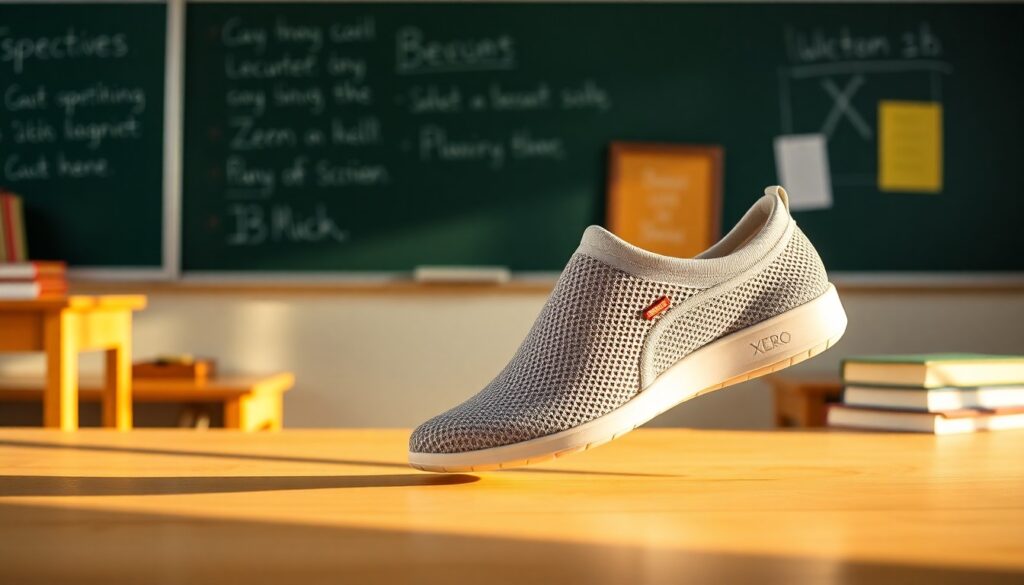
Teachers need shoes that can handle long periods of standing, quick turns between desks, and hours on hard floors. Barefoot shoes can be a strong fit for that routine when you choose the right pair and transition at the right pace.
Best fit for teachers:
Barefoot shoes help most when you want room for toe splay, a level heel-to-toe platform, and a lighter feel for classroom movement. They are less ideal if you need strong medical arch support right away or you plan to jump straight into all-day wear without a transition.
If you want the broader standing-fatique angle, see our all-day standing guide for Xero Shoes. This page stays focused on the classroom decision: what teachers need, what to avoid, and how to pick a pair that works for school days.
Why Teachers Often Do Well In Barefoot Shoes
Teaching is not a single activity. You stand at the board, walk to desks, crouch to help students, carry supplies, and often spend part of the day on hard indoor flooring. That pattern favors shoes that let your feet move naturally instead of fighting a stiff structure all day.
Barefoot shoes can help by giving your toes room to spread, keeping your heel and forefoot level, and reducing the sensation of being boxed in. For many teachers, that means less end-of-day tightness in the calves, arches, and lower back. The benefit is not magic; it is about removing unnecessary restriction so your body can work more efficiently through a busy classroom schedule.
If you are also comparing models for walking-heavy days outside school, it helps to look at adjacent use cases too. The all-day comfort and walking guide is useful when your routine shifts from classroom time to long commutes, errands, or campus walking.
What Makes A Barefoot Shoe Classroom-Friendly
The best classroom pair is not just “minimalist.” It has to match the surfaces, pace, and dress expectations of the school day. That usually means a shoe that feels light on your feet, looks neat enough for professional wear, and grips reliably on tile, laminate, or polished hallways.
Wide Toe Box
A roomy front gives your toes space to relax and splay. That matters when you spend hours standing in place and then move quickly across the room. Narrow toe boxes may look tidy, but they can amplify pressure and fatigue across a long teaching day.
Zero-Drop Platform
A level sole keeps your heel and forefoot close to the same height, which can help posture feel more natural. For teachers who already spend too much time leaning forward over a desk or whiteboard, that simpler stance can be easier to manage than a heeled shoe.
Slip Resistance And Stable Footing
Schools create odd traction problems: shiny floors, rainy entrances, stairs, and quick pivots around desks. A barefoot shoe still needs enough outsole grip to feel secure. Teachers who supervise younger students or move between classrooms should give traction more attention than they might on a casual weekend shoe.
Lightweight Construction
When your day includes dozens of small steps and constant repositioning, less weight can mean less effort. A lighter shoe often feels easier to wear from the morning bell to after-school pickup without the heavy, dragging sensation some traditional shoes create.
Professional Enough To Wear Every Day
Not every barefoot shoe looks classroom-ready, so style matters. Clean lines, neutral colors, and low-profile shapes help the shoe disappear into a standard work outfit instead of reading like athletic gear.
If your feet already feel tender, compare classroom comfort with recovery support before you choose. The best barefoot shoes for comfort on the go guide is a helpful next stop for lighter, high-mobility use cases, while the Groundies shoes overview can help if you want a more polished everyday look.
When Barefoot Shoes Help, And When They Do Not
The right choice depends on how your feet feel now and how much support you truly need. Barefoot shoes are often a good match if you want more room in the toe box, dislike the bulky feel of cushioned shoes, and want a shoe that works with natural movement instead of against it.
They are less ideal if you rely on a custom orthotic, if you have a condition that requires specific medical support, or if you are expecting immediate comfort without any adaptation. Some teachers jump into minimalist shoes too quickly and then mistake normal transition soreness for a bad shoe. That is why gradual use matters.
For readers deciding whether barefoot footwear is worth it at all, the related teacher-focused explainer covers the main teacher-specific benefits in more detail.
How To Choose The Right Pair For A School Week
A good classroom shoe needs to work on Monday morning, on rainy duty days, and through the late-afternoon period when your energy dips. The easiest way to narrow the options is to judge each pair against your real routine rather than a generic product claim.
| School-day need | Why it matters | Best sign to look for |
|---|---|---|
| Long standing periods | Standing at the board or supervising class can create foot fatigue fast | Flexible sole, low weight, even pressure distribution |
| Frequent walking | Teachers often cover more distance than they expect | Smooth transition underfoot, secure fit, easy stride |
| Polished floors | Hallways and classrooms can be slippery when wet or dusty | Reliable outsole pattern and steady grip |
| Neat dress code | Many schools expect a clean, professional look | Simple design, low-profile shape, muted color |
| Transition from traditional shoes | Switching too fast can create soreness | Start with short wear periods and increase slowly |
If you are comparing brands, do not stop at marketing language. Try the shoes on at the end of the day when your feet are slightly more swollen, and test whether your toes can spread without pressure. A pair that looks sleek but squeezes the front of the foot will usually become a problem by midweek.
Sizing guides can help, but fit is personal. Some teachers prefer a little extra room for socks or swelling during long standing days, while others need a more secure midfoot hold for fast movement between rooms. If the shoe bends naturally at the forefoot and does not pinch the heel, you are closer to the right fit.
What To Look For In Everyday Classroom Wear
- Flexible soles that bend where your foot bends
- Breathable uppers for warm rooms and long indoor days
- Simple closures that adjust quickly before the school bell
- Enough ground feel to move naturally without feeling harsh
- Materials that look tidy with work outfits
What To Avoid
- Toe boxes that taper sharply at the front
- Heavy midsoles that make you feel planted in place
- Soles with weak grip on smooth floors
- Overly stiff uppers that need a long break-in period
- Styles that clash with dress code expectations
Comfort Habits That Help Even More
Good shoes help, but classroom comfort also improves when you change how you use them. Shifting your weight, stepping away from the same spot, and giving your feet a few short movement breaks can make a bigger difference than most people expect.
If you stand in one place for long stretches, an anti-fatigue mat near your desk or teaching station can take some load off your feet. It will not replace good footwear, but it can soften the hardest moments of the day. For teachers who are on their feet from the first period to dismissal, that extra buffer is worth considering.
A simple recovery routine matters too: stretch your calves, roll the sole of your foot with a small ball, and give your feet time to relax after work. If you are moving into barefoot shoes after years of cushioned footwear, short wear periods are the safest way to start.
A Practical Way To Transition Without Overdoing It
Teachers usually do best with a slower transition than the product pages suggest. Start with a short commute, a planning period, or part of a teaching day, then build up as your feet adapt.
- Wear the shoes for short blocks first, not a full day on day one
- Alternate with your current shoes for the first couple of weeks
- Increase time on hard floors only after your feet feel comfortable
- Back off if you feel sharp pain rather than normal adaptation soreness
For teachers who want a more gradual entry into minimalist footwear, the comfort-on-the-go guide is a natural companion piece, especially if your schedule includes commuting and campus walking in the same pair.
Where To Go Next If You Are Shopping Now
If your goal is classroom comfort rather than a purely athletic barefoot shoe, focus on models that look professional, grip well on indoor floors, and give your toes enough space to relax. That combination usually serves teachers better than a shoe built mainly for running or trail use.
If you are already leaning toward Xero and want the broader standing perspective before you buy, open the all-day standing guide in a new tab and compare it against this teacher-specific page. That keeps your decision anchored in the real demands of the classroom.
For another narrow perspective, the teacher-benefits article is useful if you want a quick compare-and-contrast before choosing a pair.
FAQ: Barefoot Shoes For Teachers
Are Barefoot Shoes Good For Teachers?
They can be a very good option for teachers who want more toe room, a lighter feel, and a natural foot position during long school days. They work best when you choose a classroom-friendly model and transition gradually.
Why Are Podiatrists Against Barefoot Shoes?
Many podiatrists are not against them outright; they are cautious because some people need more support, need a slower transition, or have foot issues that may not tolerate minimalist footwear immediately. The concern is usually about fit, adaptation, and the individual wearer, not the category alone.
What Shoes Do Podiatrists Recommend For Teachers?
Recommendations vary, but for teachers the key features usually include good fit, stable footing, room for the toes, and enough comfort for long standing. Some people need structured support, while others do better in a more flexible barefoot-style shoe.
Who Should Not Wear Barefoot Shoes?
People with certain medical conditions, unresolved pain, or a strong need for custom support should get individualized advice before switching. If you already know that your feet require orthotic support, do not treat barefoot shoes as an automatic replacement.
Do Teachers Need To Size Up In Barefoot Shoes?
Sometimes, yes, but not always. Teachers often prefer enough extra room for toe splay and end-of-day swelling, yet the heel and midfoot still need to feel secure. The best answer is based on fit, not a fixed rule.

Ethan Marshall is a passionate writer and content creator at My Shoes Finder, where he explores a diverse range of topics, from lifestyle and fashion to innovative products and personal development. With a keen eye for detail and a commitment to delivering engaging and informative content, Ethan connects with readers by sharing insights that inspire and inform. He believes in the power of storytelling to influence positive change, and he continually seeks to provide valuable perspectives that resonate with his audience.
See also:
 Are Barefoot Shoes Good For Teachers? A Practical Classroom Fit Guide
 Xero Shoes For Children In 2025: Fit, Safety, And Best Models
 Are Xero Shoes Good For Standing All Day? Best Uses, Limits, And Comfort Tips
 Child Foot Development: Barefoot Vs Shod Effects On Arches And Gait
 Barefoot Footwear For Standing Jobs: Is It The Right Work Shoe For Long Shifts?
 Xero Shoes For Kids: Are They Safe, And When Do They Make Sense?
You’ve really hit the nail on the head with this post! As a teacher who spends most days on my feet, I can totally relate to the fatigue that comes from traditional shoes. I remember trying to power through long classes with those stiff soles and heel elevations—what a challenge! Since switching to barefoot shoes, I’ve noticed a huge difference in how my feet feel at the end of the day. It’s like they truly understand the natural shape and movement of my foot.
I couldn’t agree more with your insights on barefoot shoes for teachers! After making the switch to barefoot footwear myself, I’ve noticed a significant difference in how my feet feel at the end of a long day. It’s like my body has finally caught up with the natural design of my feet.
It’s great to hear you’ve found that switch to barefoot footwear so beneficial. I think there’s something really empowering about going back to a more natural state with our feet, especially given how much time we spend on them as teachers. It’s almost like our bodies are telling us what they’ve always needed, right?
It’s interesting how much our footwear can impact our overall well-being, especially in a profession like teaching that demands so much from our bodies. I remember when I first transitioned to barefoot shoes, I was surprised by how my posture and balance improved. It made me realize how often we compromise our natural mechanics for style or tradition.
It’s fascinating to see the growing recognition of how crucial proper footwear is for those of us in the teaching profession. I’ve spent many years in the classroom and can definitely relate to the fatigue that comes from long hours on our feet. When I transitioned to barefoot shoes, I noticed an incredible difference—not just in comfort, but also in how it positively impacted my energy levels throughout the day.
I found your insights on barefoot shoes particularly resonant, especially as someone who has spent years in the classroom. The sheer number of hours we spend on our feet can truly take a toll, and I’ve often noticed the strain from conventional footwear. It’s fascinating how our shoes can either enhance or compromise our comfort throughout the day, isn’t it?
I couldn’t agree more with your points about barefoot shoes being a transformative choice for teachers! As someone who has spent long hours in the classroom, I’ve experienced firsthand how traditional footwear can lead to discomfort and a noticeable dip in energy levels as the day goes on. Transitioning to barefoot shoes has truly been a revelation.
It’s interesting to hear about your experience with barefoot shoes, especially as a teacher. I can imagine how long days on your feet could take a toll, and it’s great that you found something that’s made such a difference for you. I’ve read some studies that suggest barefoot shoes can really help with posture and foot strength, which resonates with a lot of educators, considering how much standing and moving around we do.
I’ve recently made the switch to barefoot shoes myself, and it’s been quite a transformation. As a teacher, I often found myself battling soreness and fatigue by the end of the day. It’s amazing how much a shoe can impact our overall comfort and posture. I appreciate how you highlighted the flexibility and the wide toe box—those features have genuinely made a difference in how I feel while teaching.
You’ve highlighted such an essential point about the often-overlooked impact of footwear on our daily lives, especially in demanding professions like teaching. I’ve recently transitioned to barefoot shoes, and the difference has been remarkable. The wide toe box and natural flexibility make my feet feel more liberated and energized throughout the day.
I completely resonate with your insights on barefoot shoes for educators! After trying them myself, I’ve noticed such a significant difference in my energy levels during long teaching days. The wide toe box and zero-drop design really do help with posture and comfort.
You raise some interesting points about the benefits of barefoot shoes for teachers. However, I can’t help but wonder if the transition to such footwear might not be as seamless for everyone as you suggest. While the wide toe box and zero-drop design feel great in theory and can indeed foster better posture and reduced fatigue, many educators might face a challenge adapting, especially if they’ve been used to traditional shoes for years.
You bring up a really valid point about the transition to barefoot shoes. It’s true that the idea of a wide toe box and zero-drop design sounds appealing, but the reality of adapting to such a significant change in footwear can be pretty daunting for many. I remember when I first started wearing minimalist shoes, it took me some time to get used to the different sensations and support levels.
The exploration of footwear designed for educators really resonates with me, especially considering the unique demands placed on teachers every day. I often reflect on my own journey with footwear and how it has impacted my energy levels and overall well-being in the classroom. For years, I struggled with traditional shoes that seemed to promise support but instead confined my feet, leading to fatigue and discomfort. It wasn’t until I made the switch to a more natural shoe design that I began to truly appreciate the difference it could make in my daily routine.
It’s great to hear you share your journey with footwear, especially how it relates to your experience as an educator. I can definitely relate to the idea that traditional shoes often fall short in the support department. It’s a common struggle for many of us who spend so much time on our feet, navigating from one classroom to another or leading various activities throughout the day.
I can relate to your journey with footwear and the impact it can have on our day-to-day experiences, especially as educators. It’s interesting how something as seemingly simple as shoes can significantly influence our energy levels and comfort while teaching. I remember when I first started noticing just how much traditional shoes restricted my movement and left my feet aching by the end of a long day.
It’s interesting to hear about your journey with footwear as an educator. The challenges you faced—toiling in shoes that promised support but ultimately caused discomfort—are something many teachers can relate to. When you’re on your feet all day, the right shoes become essential, not just for comfort but for your overall ability to engage with students effectively.
I’m really intrigued by the benefits of barefoot shoes, especially for teachers! Having spent long hours on my feet myself, I can relate to the struggle of finding shoes that offer comfort without sacrificing style. I’ve recently made the switch to barefoot shoes, and I’ve noticed a dramatic decrease in fatigue during the school day. It feels great to finally give my feet the freedom they deserve!
It’s great to hear that you’ve made the switch to barefoot shoes and are feeling the benefits, especially as a teacher! Standing for long periods can really take a toll, and it’s fascinating how something as simple as our footwear can change how we feel throughout the day.
I couldn’t agree more! As a teacher, my feet often feel like they’re auditioning for a role in “The Walking Dead” after a long day. I used to think all shoes were just tools of torture until I found barefoot shoes. They’re like a foot hug that lets your toes throw a little dance party while still being able to stand on your feet for eternity.
It sounds like you’ve been through the wringer with your footwear. I can almost picture your poor feet auditioning for that role, exhausted and begging for mercy after a marathon of classroom chaos. Thankfully, barefoot shoes swoop in like a superhero for your soles. Who knew you could turn a dreaded footwear dilemma into a foot fiesta?
It’s great to hear your take on this. “Auditioning for a role in ‘The Walking Dead’” is such a vivid way to describe those long days. I think a lot of us can relate to that feeling of foot fatigue after standing or walking for hours. The shift to barefoot shoes sounds like a game changer. There’s something liberating about letting your feet move more naturally, isn’t there?
It really is an interesting analogy, isn’t it? “Auditioning for a role in ‘The Walking Dead’” conjures up some pretty vivid imagery. Those long days can feel endless, and the foot fatigue seems to be a universal struggle for many of us, especially if we don’t take proper care of our feet. I felt the impact of that during a recent hiking trip where I wore my traditional shoes instead of the barefoot ones I’ve been experimenting with. By the end of the day, it was like my feet were begging for mercy.
It’s great to hear that you’ve had such a positive experience with barefoot shoes! They really do change the game, especially for those of us on our feet all day. It’s fascinating how something as simple as a shoe can completely redefine comfort and support.
I found your insights on barefoot shoes for teachers particularly relevant, as I’ve recently jumped into the world of minimalist footwear myself. The demands of teaching can indeed take a toll on our bodies, and it’s easy to overlook how much our choice of footwear impacts our overall well-being. The rise of barefoot shoes couldn’t come at a better time, especially as more educators are becoming aware of the importance of natural movement.
It’s great to hear you’ve jumped into the world of minimalist footwear! It’s like discovering a secret club where the dress code is comfy and your toes can finally breathe. Teaching can feel like running a marathon in slow motion—without the shoes that support you, it’s a trail of aches and pains.
It’s fascinating to see shifting perspectives on footwear, particularly in professions like teaching where comfort is paramount. Having been in a similar role, I can absolutely relate to the struggles of finding shoes that support long hours on our feet without sacrificing mobility or style. I made the switch to barefoot shoes a couple of years ago, and it significantly changed my day. The wide toe box allowed my feet to spread naturally, leading to reduced fatigue, which you highlighted beautifully.
I’ve got to say, the moment I slipped on my first pair of barefoot shoes, it felt like my toes were throwing a welcome home party! It’s like finally letting my feet breathe after a lifelong stint in shoes that felt like medieval torture devices. Now, when I’m navigating through a swarm of hyperactive kids at recess, I feel like I’m walking on clouds instead of plotting my escape route.
I couldn’t agree more with your insights about barefoot shoes and their transformative impact on educators who spend so much of their day on their feet! As a teacher myself, I know firsthand the toll that long hours of standing and moving can take on our bodies. It’s often a balancing act between staying comfortable and looking professional, yet barefoot shoes seem to bridge that gap beautifully.
As someone who spends long hours teaching, I can truly appreciate the difference a good pair of shoes makes. When I first switched to barefoot shoes, I was amazed at how much my posture improved and, surprisingly, my energy levels throughout the day. It felt liberating to let my feet move more naturally, and I could focus more on my students rather than my achy feet.
I can totally relate to your experience with barefoot shoes. It’s interesting how something as simple as footwear can have such a profound impact on both our posture and our overall energy levels. I remember when I first made the switch, I felt like my feet were finally free to do their job naturally instead of being confined. It’s easy to underestimate how much proper alignment and comfort can affect our performance, especially during long teaching sessions.
You’ve made some excellent points about the benefits of barefoot shoes for teachers. As someone who has spent long days on their feet in a classroom, I’ve often felt the weariness that comes from traditional shoes. The zero-drop design and wide toe box you mentioned really do allow for better natural movement, which not only supports foot health but can also have a ripple effect on overall well-being.